Reinforced concrete remains the default frame for repetitive floor plates, robust fire performance and acoustic separation. Our network’s RC frame contractors handle everything from foundations to the topmost slab, working to the structural engineer’s design and the main contractor’s programme.
What This Package Covers
- In-situ columns, beams, walls and slabs
- Reinforcement fixing, formwork and falsework
- Concrete supply coordination and pour sequencing
- Crane and material-handling strategy
- Temporary works design and propping
- Quality control, cube testing and as-built records
When It’s the Right Choice
- Repetitive residential and student floor plates
- Buildings needing high fire and acoustic performance
- Schemes where robustness and durability matter most
- Sites with good labour availability for steady pour cycles
The Complete Guide
Reinforced Concrete (RC) Frames Explained
Reinforced concrete frames are the structural skeleton behind a huge share of the buildings around us, from city-centre offices and apartment blocks to multi-storey car parks, hospitals, schools and deep residential basements. The method has been refined for well over a century, and it remains one of the most dependable, versatile and widely used ways to put a building up.
This guide explains everything in plain language: what an RC frame actually is, why concrete and steel are such a good pairing, the parts that make up a frame, the framing systems, how a frame is built on site, the UK design rules, the real advantages and genuine drawbacks, how it compares with steel and timber, the defects to watch for, and where the industry is heading on sustainability and cost.
What Is a Reinforced Concrete Frame?
A reinforced concrete frame is a load-bearing structure made from concrete that has steel bars (reinforcement, usually called rebar) embedded inside it. The frame is built from a connected grid of vertical and horizontal members (mainly columns, beams and slabs) that collect the loads acting on a building and carry them safely down into the foundations and the ground below.
The word “reinforced” is the important part. Plain concrete on its own is excellent at one job and poor at another, and adding steel solves the weakness. That single idea is the foundation of the whole method, so it is worth understanding properly before going any further.
Why Concrete and Steel Work So Well Together
Concrete is very strong in compression. It copes well with being squashed or pressed. It is weak in tension, however, which means it cracks and fails easily when it is pulled or stretched. Steel is the opposite in practical terms: it is strong in tension and behaves predictably under load.
When you cast steel bars into concrete, you get the best of both materials in one element. The concrete handles the compression, the steel handles the tension, and the combined member can resist bending, which always produces compression on one face and tension on the other.
Three further properties make the partnership work in practice rather than just in theory.
- Similar thermal movement. Steel and concrete expand and contract at almost the same rate when the temperature changes. Because they move together, the bond between them stays intact through normal heating and cooling.
- A protective chemical environment. Fresh concrete is highly alkaline, and that alkalinity forms a thin passive layer on the steel that protects it from rust. As long as that environment is maintained, the embedded steel can last for decades.
- A strong physical bond. Reinforcing bars are rolled with ribs so the concrete grips them mechanically, letting the two materials transfer force between each other rather than slipping apart under load.
The steel is normally placed where the tension occurs, so reinforcement detailing follows the way forces flow through each member. Getting that placement right is one of the central skills of reinforced concrete design.
The Main Components of an RC Frame
Every reinforced concrete frame is assembled from a handful of recurring elements, each with a specific job.
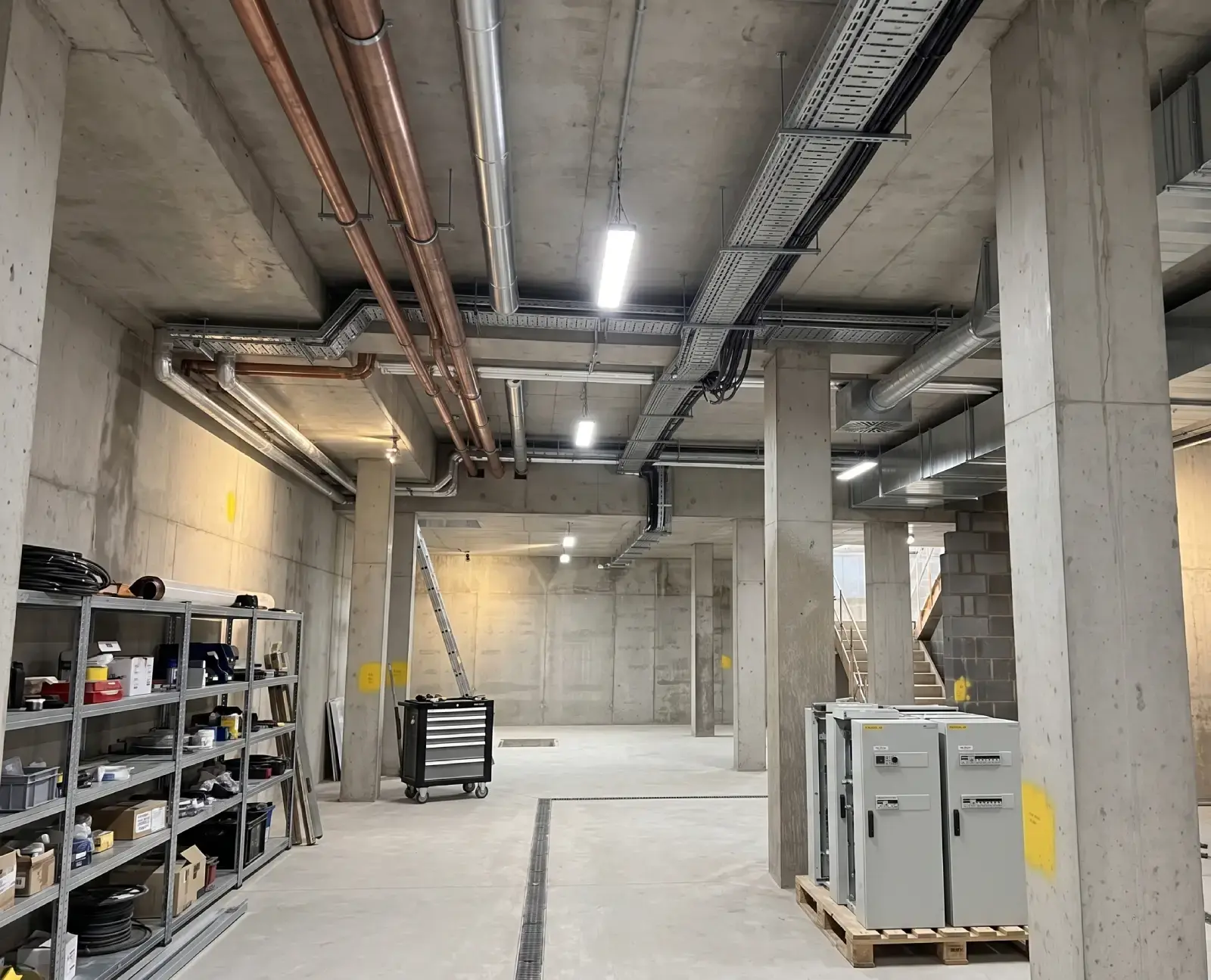
- Columns. Vertical members. Primarily compression elements that gather the loads from the floors above and carry them downward, level by level, into the foundations.
- Beams. Horizontal members that span between columns. They support the floor and roof slabs and resist bending and shear as those loads try to deflect them.
- Slabs. The floors and ceilings, the surfaces people stand on. They spread loads onto the beams or directly onto the columns, depending on the system used.
- Foundations. Pass the whole building’s load into the ground: isolated pad footings, combined footings, strip foundations, raft slabs, and pile caps where shallow ground is too weak.
- Shear walls and cores. Solid concrete walls, often around lift shafts and stairwells, that stiffen the building against sideways forces such as wind. Essential in taller buildings.
- Beam-column joints. Where members meet. Among the most heavily stressed and carefully detailed parts of any frame, because forces change direction and transfer between members here.
Types of RC Frame Systems
There is no single way to arrange a concrete frame. The right choice depends on the spans required, the loads, the floor-to-floor height available, the speed of construction and the look the architect wants. These are the systems you will come across most often.
- Beam-and-slab (conventional). A grid of beams between the columns, with slabs spanning onto the beams. The traditional arrangement, well suited to heavy or irregular loads.
- Flat slab. The slab sits directly on the columns with no downstand beams. Drop panels or widened column heads handle the concentrated forces. A flat soffit simplifies services and reduces floor depth.
- Flat plate. Like flat slabs but without the drops or column heads. The thinnest possible floor zone, used where spans and loads are modest.
- Waffle and ribbed slabs. A grid of small ribs cast into the underside removes concrete where it is not needed, making the floor lighter and able to span further, useful for large open spaces.
- Moment-resisting frames. Rigid beam-to-column connections let the frame resist sideways loads through the stiffness of its joints.
- Braced and unbraced frames. A braced frame leans on shear walls, cores or bracing for stability; an unbraced frame depends on the frame action of its own members.
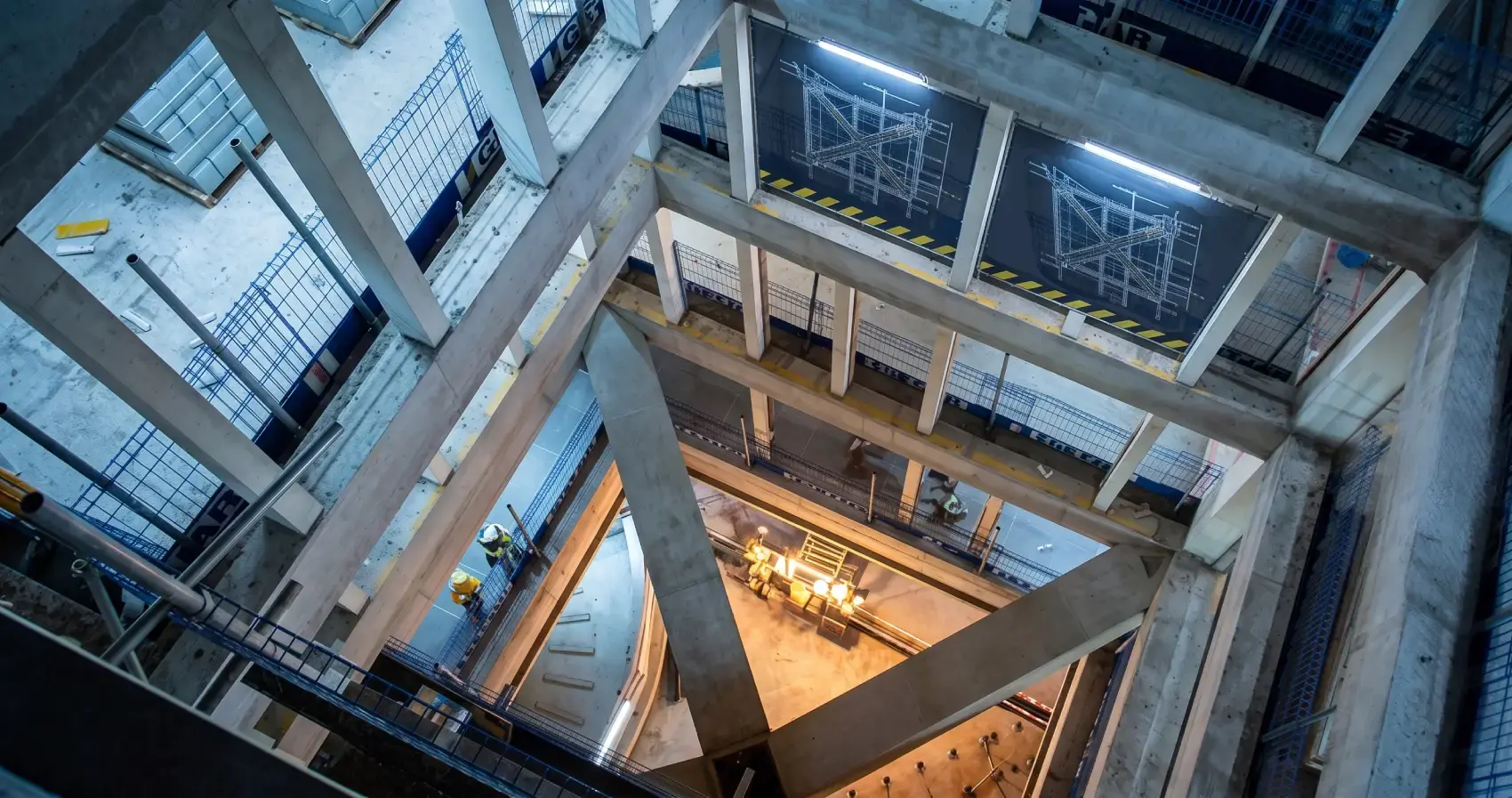
Cast In-Situ, Precast and Hybrid Construction
Cast in-situ (cast-in-place) means the concrete is poured into formwork on site, in its final position. This is the most flexible method, copes well with complex shapes and awkward sites, and produces a monolithic structure with continuous connections. The trade-off is that it is weather dependent and the programme must allow time for each pour to cure and gain strength.
Precast concrete is manufactured off site in a controlled factory, then transported and lifted into place. Factory conditions give excellent quality control and a smooth finish, and erection is fast because there is no waiting for concrete to cure. The limits are the size and weight of units that can be transported and craned, and the need for carefully designed connections.
Hybrid construction combines the two, for example precast columns and beams with cast in-situ slabs or connections. It is increasingly common because it balances speed, quality and buildability against cost and flexibility.
Materials: Concrete, Steel and Admixtures
A reinforced concrete frame is only as good as the materials that go into it.
- Concrete. A mix of cement, water, fine aggregate (sand) and coarse aggregate (gravel or crushed stone). Strength is specified by grade, in the UK and Europe by Eurocode notation such as C25/30 or C32/40, where the numbers are the characteristic compressive strength in megapascals on cylinders and on cubes. The water-to-cement ratio is critical: too much water weakens the hardened concrete and reduces durability.
- Reinforcing steel. In the UK normally grade B500 (B500B and B500C ductility classes), where 500 is the characteristic yield strength in megapascals. Older buildings may contain mild steel (grade 250) or earlier high-yield bars (grade 460), which matters when assessing or refurbishing existing structures.
- Admixtures. Chemicals added in small quantities to change how concrete behaves. Plasticisers and superplasticisers improve workability without adding water; retarders slow the set and accelerators speed it up; air-entraining agents help resist freeze-thaw damage; waterproofing admixtures are common in basements.
How a Reinforced Concrete Frame Is Built
On site, an in-situ frame goes up in a repeating sequence, floor by floor.
- Formwork is erected. Temporary moulds (shuttering) define the exact shape, size and position of each beam, column, wall and slab. Accuracy here governs the accuracy of the finished structure.
- Reinforcement is fixed. Steel bars and mesh are cut, bent and tied into cages exactly as the drawings specify. Spacers hold the steel off the mould faces so the correct depth of concrete surrounds it.
- Concrete is poured and compacted. Concrete is placed and compacted, usually with poker vibrators, to drive out trapped air. Air voids leave weak, porous patches.
- The concrete cures. It is kept protected and ideally moist while it hardens. Curing is a chemical reaction, not simply drying. Rushing it leads to weaker, crack-prone concrete.
- The formwork is struck. Once the concrete can support itself and the next stage, the formwork is carefully removed and moved on. Props are often left longer to support slabs until they reach full strength.
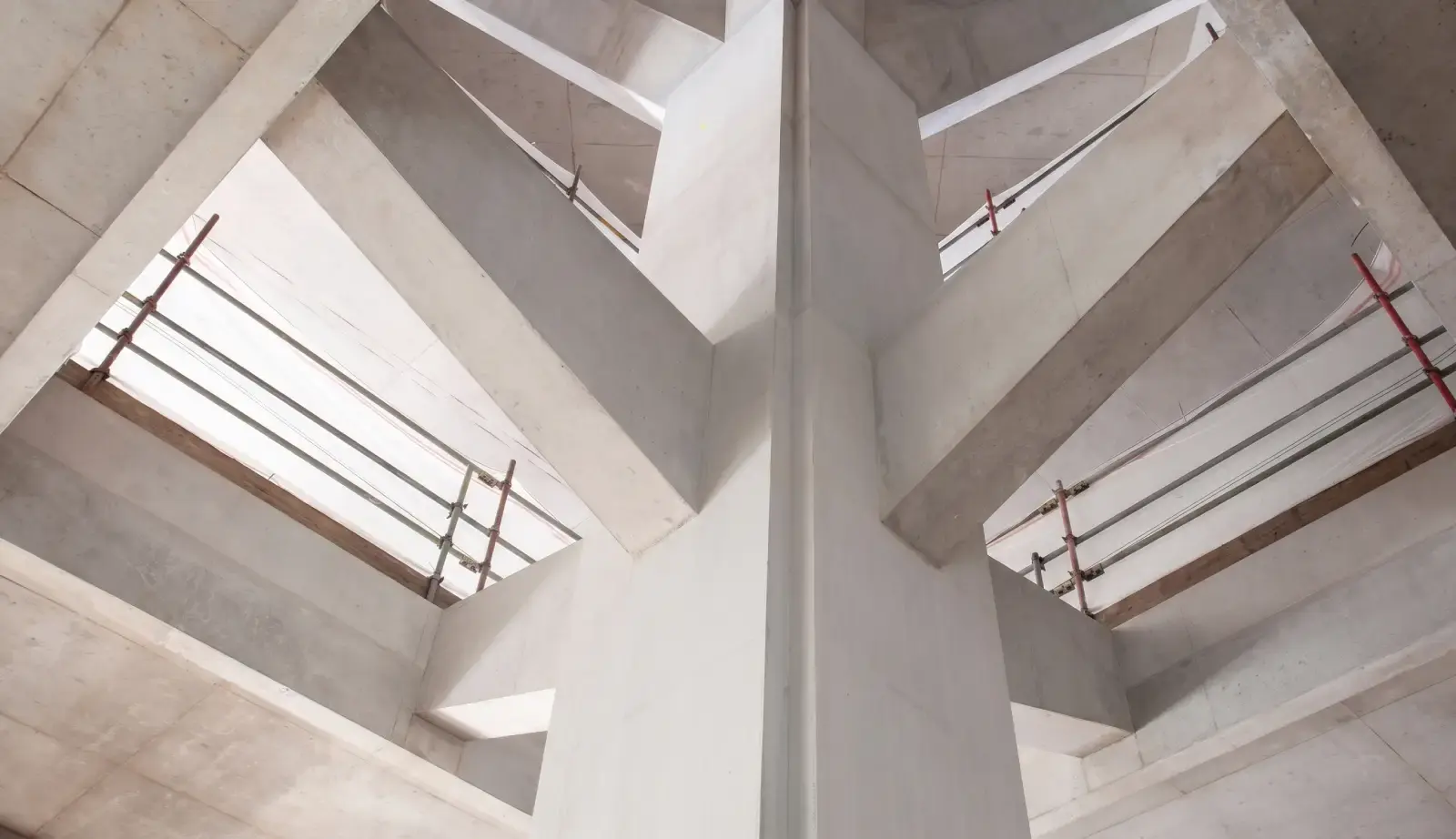
Quality control runs through every step, with checks on the steel, slump tests and cube tests on the concrete, and surveys of alignment and level.
Formwork Systems Compared
Formwork is far more than a temporary inconvenience. The system chosen affects the speed of the build, the accuracy of the structure, the surface finish and the overall cost.
| Type | What it is | Main strengths | Typical use |
|---|---|---|---|
| Timber | Plywood and timber boards cut to suit | Cheap, flexible, easy to shape on site | Bespoke or irregular pours, feature walls, small jobs |
| Steel | Reusable steel panels and frames | Very accurate, smooth finish, many reuses | Repetitive elements, columns, cores, high-rise |
| Aluminium | Lightweight aluminium panel systems | Fast to assemble, light, corrosion resistant | Repetitive layouts, multi-unit housing, fast-track |
| Plastic | Modular reinforced-plastic panels | Light, moisture resistant, easy to clean and reuse | Medium-scale repetitive work, wet environments |
| Fabric | Flexible high-strength membranes | Allows curved shapes, uses less material | Architectural and curved concrete features |
| Permanent (incl. ICF) | Panels that stay in place, often insulated | No striking; adds insulation and fire resistance | Basement and retaining walls, energy-efficient walls |
Insulated concrete formwork (ICF) deserves a particular mention: it stays in place permanently and provides built-in thermal insulation, which makes it popular in low-energy and Passivhaus-style buildings.
Design Standards and Key Considerations in the UK
Reinforced concrete design in the UK is governed by the Eurocodes, principally Eurocode 2 (BS EN 1992) for concrete structures, alongside Eurocode 0 for the basis of design and Eurocode 1 for the loads (actions) a structure must resist. These replaced the older British Standard BS 8110, which you will still encounter on existing buildings.
- Loads. Engineers account for permanent (dead) loads, imposed (live) loads from people and equipment, wind, snow and, where relevant, seismic loads, each combined with appropriate safety factors.
- Concrete cover. The depth of concrete protecting the steel from the surface, set to guard against corrosion and fire. The required cover depends on exposure conditions, grouped into classes from dry interiors to marine and de-icing-salt environments.
- Fire resistance. Concrete performs well in fire, but cover and member sizes are still chosen to give a specified fire-resistance period, because steel loses strength at high temperatures and the cover shields it.
- Durability. Mix design, cover and crack control are all set with the building’s intended lifespan and environment in mind.
- Coordination with other trades. Holes, fixings and penetrations for services, waterproofing and facades are far easier to plan into the design than to cut in later, so early coordination avoids costly rework.
The Benefits of Reinforced Concrete Frames
- Strength and stability. They carry heavy loads and resist impact and environmental stress reliably.
- Excellent fire resistance. Concrete is non-combustible and protects the steel inside it, often reducing the need for added fire protection compared with bare steelwork.
- Durability and low maintenance. A well-built, well-detailed frame can last a very long time with little upkeep.
- Design flexibility. Cast in-situ concrete can be moulded into almost any shape, supporting open-plan layouts, long spans and complex geometries.
- Thermal mass. Its density lets it absorb and release heat slowly, smoothing temperature swings and improving energy performance.
- Acoustic performance. That same density reduces sound transmission between floors and rooms.
- Locally available materials. Aggregates and cement are widely available, and the skills to work them are well established.
The Drawbacks and Limitations
- Weight. Concrete is heavy, so frames impose large loads on the ground and tend to need bigger, more expensive foundations than lighter systems.
- Speed. In-situ concrete needs time to cure before work continues, so the frame programme can be slower than an equivalent steel frame, especially in cold weather.
- Formwork cost and labour. Formwork can be a large share of the cost, and the work is labour intensive and needs skilled operatives.
- Sensitivity to workmanship and weather. Finished quality depends heavily on good placing, compaction and curing; poor conditions or practice can cause lasting defects.
- Difficult to alter or demolish. A monolithic frame is hard to modify, cut into or take down later, reducing flexibility over a building’s life.
- Carbon footprint. Cement production is energy intensive and a significant source of carbon dioxide emissions, a major focus for the industry.
RC Frame Versus Steel and Timber
Choosing a structural system is a balancing exercise. This comparison shows where each material tends to win.
| Factor | Reinforced concrete | Structural steel | Timber (incl. engineered) |
|---|---|---|---|
| Strength to weight | Heavy for its strength | Excellent, light and strong | Good for its low weight |
| Construction speed | Slower, needs curing time | Fast, dry, predictable | Fast, especially prefabricated |
| Fire resistance | Very good, non-combustible | Needs added protection | Chars; needs careful design |
| Spans | Good, very good with the right system | Excellent for long spans | Moderate, improving |
| Maintenance | Low | Needs corrosion protection | Needs moisture and pest protection |
| Sound / thermal mass | Excellent | Poor on its own | Poorer on its own |
| Carbon profile | High unless low-carbon mixes | Moderate, highly recyclable | Low, can store carbon |
| Cost | Competitive, especially at scale | Often higher material cost | Varies, can be very competitive |
In practice many modern buildings combine materials (for example a concrete core and foundations with a steel or timber frame above) to play to each material’s strengths.
When to Choose a Reinforced Concrete Frame
Reinforced concrete tends to be the natural choice in a number of situations.
- Multi-storey developments. where strong vertical load-bearing capacity is needed floor after floor.
- Basements and below-ground structures. where structural strength and good resistance to water make concrete an obvious fit.
- Buildings where fire and acoustic separation matter. such as hospitals, hotels and apartment blocks.
- Structures with heavy or unusual loads. including industrial buildings, car parks and water-retaining structures.
- Projects where durability and low maintenance. outweigh a slower initial build.
Involving a specialist concrete contractor early (during the design phase rather than after it) usually pays off. It lets the frame be optimised for buildability, cost and programme, and helps the structure, waterproofing and fit-out work together smoothly.
Common Defects and How They Are Prevented
- Cracking. Plastic shrinkage cracks form while concrete is fresh if the surface dries too fast; drying-shrinkage and thermal cracks appear as it cures; structural cracks point to overloading or design issues; and settlement cracks follow ground movement. Some hairline cracking is normal, controlled through reinforcement, mix design, joints and proper curing.
- Reinforcement corrosion. The most serious long-term threat. Carbon dioxide slowly neutralises the protective alkalinity (carbonation), and chlorides from sea air or de-icing salts can reach the steel. Once protection breaks down, the steel rusts, expands and cracks the surrounding concrete off (spalling). Adequate cover, dense low-permeability concrete and correct mix design are the main defences.
- Honeycombing. A rough, voided surface caused by poor compaction or formwork leakage, leaving the concrete weak and the steel exposed. Careful placing and vibration prevent it.
- Alkali-silica reaction (ASR). Sometimes called concrete cancer, a slow reaction between certain reactive aggregates and the alkalis in cement that produces a gel which swells and cracks the concrete. Selecting suitable aggregates and cements avoids it.
A note on RAAC. It is worth distinguishing standard reinforced concrete from RAAC (reinforced autoclaved aerated concrete), which made headlines when found in UK schools and other public buildings. RAAC is a lightweight, aerated, precast material used mainly in older roof and floor panels from roughly the 1950s to the 1990s. It is much weaker and more prone to deterioration than ordinary reinforced concrete and has a limited service life, which is why ageing RAAC has needed urgent inspection and, in many cases, replacement. A conventional cast in-situ RC frame is a very different and far more robust form of construction.
Durability, Lifespan and Maintenance
A reinforced concrete frame that is well designed, well built and not exposed to aggressive conditions can readily last a hundred years or more. Lifespan depends heavily on the quality of the original work ( particularly the concrete cover and compaction) and on the environment the structure sits in.
Maintenance is generally light but not zero. Periodic inspection for cracking, spalling and signs of corrosion is sensible, especially for exposed structures such as car parks, bridges and balconies, where water and salts speed up deterioration. Where problems are found, concrete repair, additional protection such as coatings, and in some cases cathodic protection of the steel can extend a structure’s life considerably.
Sustainability and Low-Carbon Concrete
Because cement is responsible for a large share of construction’s carbon emissions, reducing the environmental impact of concrete has become a priority across the industry. Several approaches are now common.
- Cement replacements. Ground granulated blast-furnace slag (GGBS) and pulverised fuel ash (PFA, or fly ash) replace a proportion of cement with industrial by-products, cutting both emissions and cost.
- Recycled and secondary aggregates. reduce the demand for quarried material.
- Lower-carbon and novel cements. are being developed and adopted to reduce the emissions of the cement itself.
- Efficient design. that uses no more concrete than necessary (for example through voided or ribbed slabs) reduces material use at source.
- Longevity and reuse. spread embodied carbon over a much longer life, since a structure that lasts longer or whose elements can be reused is inherently more efficient.
The thermal mass and durability of concrete also count in its favour over a building’s whole life, particularly when set against the energy a building uses for heating and cooling across many decades.
What Affects the Cost of an RC Frame
Rather than a single price, the cost of a reinforced concrete frame is driven by a set of factors that vary from project to project.
- Scale and repetition. Larger jobs and repeated, identical floors let formwork and labour be reused efficiently, lowering the unit cost.
- Complexity. Irregular shapes, curves and one-off elements increase formwork and labour costs.
- Concrete grade and reinforcement quantity. Higher strengths and heavier reinforcement add material cost.
- Site conditions and access. Restricted urban sites, poor ground and difficult access all push costs up.
- Programme and speed requirements. Fast-track schemes may justify more expensive but quicker methods such as precast or aluminium formwork.
- Finish quality. A high-quality exposed (fair-faced) finish costs more than a surface that will be hidden or covered.
For an accurate figure, a frame should always be priced against the actual drawings and site, but understanding these drivers helps explain why two superficially similar buildings can cost very different amounts.
Conclusion
Reinforced concrete frames endure as one of construction’s most reliable structural systems because they combine the compressive strength of concrete with the tensile strength of steel into a material that is strong, durable, fire resistant and remarkably adaptable. They are not the right answer for every building, and they carry real trade-offs in weight, speed and carbon, but for multi-storey developments, basements and any structure where longevity and resilience matter, they are very hard to beat.
The quality of the finished frame comes down to good design, sound materials and careful work on site, from accurate formwork and correctly fixed reinforcement through to proper compaction and curing. Get those fundamentals right, and a reinforced concrete frame will stand and serve for generations.
Frequently Asked Questions
What floor cycle can an RC frame achieve?
On a repetitive plate with a well-resourced team, a typical residential floor cycle is around 6 to 10 working days, depending on plate size, complexity and crane provision.
Is RC cheaper than post-tensioned?
It depends on spans and storey count. RC is often more economical on short to medium spans; PT can win where long spans, thinner slabs or extra storeys add value. Our frame selector helps you weigh it up.
Is reinforced concrete the same as cement?
No. Cement is one ingredient. Concrete is the hardened mix of cement, water and aggregates, and reinforced concrete is that concrete with steel bars cast inside it.
How long does a reinforced concrete frame last?
A well-built frame in normal conditions can last a hundred years or more. Harsh environments and poor original workmanship shorten that, which is why cover and concrete quality matter so much.
Why does steel go inside the concrete rather than outside?
The concrete protects the steel from fire and corrosion, and the bond between the two lets them share load. Steel on the outside would rust and would not be protected in a fire.
What is concrete cover and why does it matter?
Cover is the depth of concrete between the surface and the nearest steel. It protects the reinforcement from corrosion and fire, so getting it right is one of the most important details on site.
Does reinforced concrete crack?
Some fine cracking is normal and expected. It is controlled by reinforcement, joints, sensible mix design and proper curing. Large or growing cracks should always be assessed by an engineer.