Post-tensioning lets concrete span further with less depth. PT flat slabs reduce structural zone, cut concrete and reinforcement quantities, and create column-free space, often unlocking an extra storey within the same building height. Our PT specialists cover design coordination, tendon installation and stressing.
What This Package Covers
- Bonded and unbonded PT flat slabs
- PT transfer structures and beams
- Tendon supply, installation and stressing
- Stressing records and grouting (bonded systems)
- Coordination with the PT design engineer
- Early-age strength monitoring for stressing
When It’s the Right Choice
- Long spans and column-free layouts
- Commercial offices needing shallow floor zones
- Maximising storeys within a height-limited envelope
- Reducing concrete volume and embodied carbon per m²
The Complete Guide
Post-Tensioned (PT) Frames Explained
Post-tensioned concrete is the technology behind some of the thinnest, longest-spanning and most open floor plates in modern construction. If you have parked in a multi-storey car park with very few columns, worked in an office with wide column-free floors, or driven over a long concrete bridge, there is a good chance post-tensioning was involved.
It is closely related to ordinary reinforced concrete, and it solves the same basic problem (concrete’s weakness in tension) but in a cleverer, more active way. The result is a frame that uses less material, spans further and cracks less, at the cost of more specialist design, more careful construction and some genuine safety considerations that every owner and contractor needs to understand. If you have read the companion guide on reinforced concrete (RC) frames, this is the natural next step, because post-tensioning builds directly on those same principles.
What Is a Post-Tensioned Frame?
A post-tensioned frame is a concrete structure in which high-strength steel tendons are tensioned (stretched) after the concrete has been cast and has hardened, then anchored so that they squeeze the concrete and hold it in compression. That deliberate, built-in compression is what makes the structure so efficient.
The word to understand here is prestressing, introducing internal stresses into a member before it carries any service load, so that those built-in stresses cancel out the stresses the loads will later cause. Post-tensioning is one of the two ways of achieving prestress, the other being pre-tensioning.
So while an ordinary RC frame relies on steel bars sitting passively inside the concrete and only doing their job once load is applied, a post-tensioned frame is actively pre-loaded. The concrete starts its working life already compressed, ready to resist the tension that floor loads will throw at it.
The Core Idea: Keeping Concrete in Compression
Concrete is strong in compression and weak in tension, the single fact that governs almost everything about concrete design. In a normal reinforced beam, the underside stretches under load, the concrete there cracks, and the steel reinforcement takes over the tension once it has.
Post-tensioning takes a different approach. By stressing tendons that run through the member, usually along a curved or “draped” profile, the system applies a compressive force and an upward push that counteracts the downward load. Engineers call this load balancing: the prestress is tuned so that it offsets a large share of the permanent load, leaving the concrete with far less net tension.
The practical results are striking. Because the concrete is held in compression, it cracks far less, deflects less and can be made much thinner for a given span. Less cracking also means better durability and watertightness, which is why post-tensioning appears so often in car park decks, water tanks and bridges.
Pre-Tensioning Versus Post-Tensioning
Both methods produce prestressed concrete, but the order of operations is reversed, and that changes everything about how and where they are used.
Pre-tensioning is done before the concrete is cast, almost always in a factory. Steel strands are stretched between strong abutments, the concrete is poured around them, and once it has hardened and bonded to the steel, the strands are released. As they try to return to their original length, they transfer compression into the concrete through the bond along their length. It suits standardised, mass-produced units such as precast beams, floor planks and bridge beams.
Post-tensioning is done after the concrete is cast and cured, usually in place on site. Ducts or sheaths are positioned within the formwork before the pour, tendons run through them, and once the concrete has gained enough strength the tendons are stretched with hydraulic jacks and locked off at anchorages. It suits large, cast-in-situ elements such as building floor slabs, transfer beams and long-span bridges, where casting in a factory is impractical.
In short, pre-tensioning stresses the steel first and casts around it, while post-tensioning casts first and stresses the steel afterwards. The rest of this guide focuses on post-tensioning.
Bonded Versus Unbonded Post-Tensioning
There are two families of post-tensioning system, and the difference matters for durability, design and how the structure behaves if a tendon is ever damaged.
Bonded systems run the tendons inside metal or plastic ducts. After stressing, the ducts are filled with a cementitious grout, which sets and bonds the tendon to the surrounding concrete along its entire length. This shares the tendon force continuously with the concrete rather than relying solely on the end anchorages, and the grout provides an extra barrier protecting the steel from corrosion. Bonded systems are common in beams, transfer structures and bridges.
Unbonded systems use individual strands coated in grease and sheathed in plastic, then cast into the concrete without grouting. Each strand is free to move within its sheath and transfers its force only at the anchorages at each end. They are simpler and quicker to install and very widely used in building floor slabs. The trade-off is that the whole tendon force depends on those anchorages, so anchorage design and protection are critical, and a single damaged strand affects a longer length of the structure.
Neither is universally better. Bonded systems offer more robustness and redundancy; unbonded systems offer speed and simplicity. The choice depends on the structure, the loads and the durability requirements.
The Main Components of a Post-Tensioned System
A post-tensioned frame contains everything a normal reinforced frame does, plus a specialist prestressing kit.
- Tendons. The high-strength steel elements that are stressed, usually seven-wire strand, sometimes high-strength bars. Several strands are often bundled together in one tendon.
- Ducts and sheaths. House the tendons. In bonded systems these are the ducts that will later be grouted; in unbonded systems each strand has its own greased plastic sheath.
- Anchorages. The castings at each end of a tendon that lock the prestressing force into the concrete, typically a live (stressing) end where the jack pulls, and a cast-in dead end. Wedges grip the strand inside.
- Hydraulic jacks. The equipment used to stretch the tendons to their precise design force. The extension of each tendon is measured and recorded as a quality check.
- Grout. The cementitious fill pumped into the ducts of bonded systems after stressing, providing bond and corrosion protection.
- Conventional reinforcement. Still present. Ordinary rebar handles local effects, controls cracking in anchorage zones and provides robustness, working alongside the tendons rather than replacing them.
Materials
The defining material in post-tensioning is the prestressing steel. It is far stronger than ordinary reinforcement, with a typical ultimate tensile strength around 1,860 megapascals, compared with about 500 megapascals for standard reinforcing bar. That high strength is essential, because the steel must be stretched to a high stress and still keep a large reserve of force locked in over the life of the structure, even after losses from concrete shrinkage, creep and steel relaxation.
The concrete itself is usually a higher grade than in basic reinforced work, both to carry the concentrated forces at anchorages and to limit the long-term shortening of the member under sustained compression. The grout used in bonded systems is a carefully specified cementitious mix designed to flow fully into the ducts and leave no voids, because any gap is a place where water and corrosion can later attack the tendon.
How a Post-Tensioned Slab Is Built
A cast-in-situ post-tensioned floor follows a sequence that looks familiar from ordinary reinforced concrete, with stressing and grouting added.
- Formwork and falsework are set up to support the wet concrete and define the slab.
- Bottom reinforcement is placed, providing crack control and robustness.
- Tendons are laid out and fixed to their profile. This is the heart of the method. The tendons are draped to a precise curve (high over the supports and low at midspan) so that when stressed they push against the load in the right places.
- Top reinforcement and anchorages are installed, with the stressing anchorages set at the slab edges.
- Concrete is poured and compacted around the tendons and reinforcement.
- The concrete is cured until it reaches a specified transfer strength, the minimum strength needed before the prestress can safely be applied.
- The tendons are stressed with hydraulic jacks to their design force, and the measured extensions are checked against calculations.
- Bonded ducts are grouted, filling the voids around the tendons.
- Strand tails are trimmed and anchorages are sealed to protect them.
- Formwork is struck, often earlier than for a comparable reinforced slab, because the prestress makes the floor self-supporting sooner.
Record keeping runs through the stressing operation in particular, because the elongation of each tendon is direct evidence that the correct force has been applied.
Common Post-Tensioned Systems and Applications
Post-tensioning earns its place wherever long spans, thin floors, crack control or watertightness are valuable.
- Post-tensioned flat slabs. The most common use in buildings. The slab sits directly on columns with no downstand beams, giving a flat soffit, long spans and a shallow floor zone.
- Band beam and slab systems. Wide, shallow beams in one direction with a thinner slab spanning the other, balancing span and floor depth.
- Transfer structures. Heavily loaded beams or slabs that carry columns or walls from above and redistribute their loads to a different grid below, for example where a tower meets a wider podium.
- Ground-bearing and industrial slabs. Post-tensioning creates large, crack-free floors with few or no joints.
- Bridges. One of the earliest and most important applications, using post-tensioning to span long distances efficiently.
- Water-retaining structures and tanks. Benefit from the crack control, which keeps them watertight.
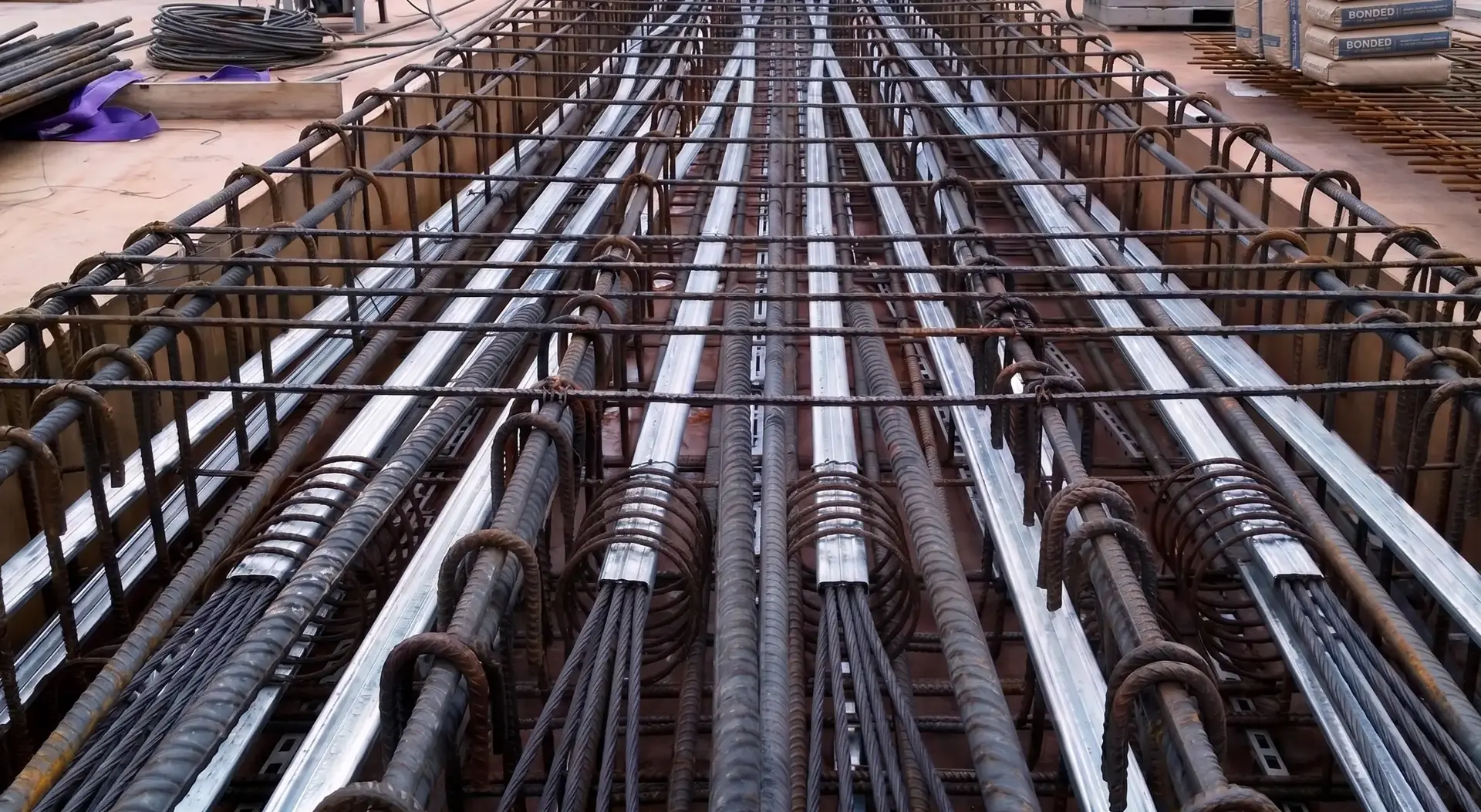
In buildings, the headline attraction is usually the combination of long spans and thin floors, which lets architects open up the plan and stack more floors within a given building height.
Post-Tensioned Versus Conventional Reinforced Concrete
Since post-tensioning is often weighed against ordinary reinforced concrete, this comparison shows where it pulls ahead and where it asks more of the project.
| Factor | Post-tensioned concrete | Conventional reinforced concrete |
|---|---|---|
| Spans | Longer spans for the same depth | Shorter spans or deeper members |
| Slab thickness | Thinner and lighter | Thicker for the same span |
| Material use | Less concrete and steel by volume | More concrete and reinforcement |
| Cracking and deflection | Well controlled by prestress | More prone to both |
| Construction speed | Often faster, earlier striking | Slower stripping, more props |
| Design complexity | Higher, needs specialist input | Well established and routine |
| Alteration and drilling | Restricted, tendons must be avoided | More forgiving |
| Demolition | More complex, stored energy | More straightforward |
| Whole-life inspection | Hidden tendons are harder to check | Reinforcement is more accessible |
The pattern is clear. Post-tensioning trades simplicity and flexibility for efficiency and performance. On the right project it can save a remarkable amount of material and create floors that ordinary reinforced concrete simply cannot match.
The Benefits of Post-Tensioned Frames
- Longer spans and fewer columns. which open up floor plates and increase usable, flexible space.
- Thinner, lighter slabs. which reduce the building’s self-weight, cut foundation loads and can allow extra floors within a height limit.
- Less material. with meaningful savings in both concrete and reinforcement, and a correspondingly lower carbon footprint.
- Excellent crack and deflection control. because the concrete is held in compression, improving durability, appearance and watertightness.
- Faster construction. in many cases, since slabs can often be struck earlier and there are fewer columns to build around.
- Better performance in demanding uses. such as car park decks and water tanks, where crack control directly protects the structure.
The Drawbacks and Limitations
An honest assessment has to be just as clear about the downsides.
- Specialist design and construction. Post-tensioning needs experienced designers and accredited specialist contractors, and the stressing operation demands skilled operatives and careful records.
- You cannot drill or cut freely. Tendons run through the slab on specific profiles. Hitting one when fixing services, coring a hole or forming a new opening can be dangerous and structurally serious. Any penetration must be planned and the tendons located first.
- Corrosion of tendons is a serious risk. Prestressing steel is highly stressed and far less tolerant of corrosion than ordinary rebar. Poor grouting or failed anchorage protection can let water reach the steel, with severe consequences.
- Difficult and hazardous to alter or demolish. A post-tensioned member stores a large amount of energy. Cutting tendons without proper procedures can cause a sudden and dangerous release.
- Sequencing and quality control are critical. Concrete must reach its transfer strength before stressing, grouting must be complete, and anchorages must be protected, all in the right order.
- Inspection over the building’s life is harder. Because tendons are hidden inside the concrete, problems can develop unseen, which puts a premium on good design and good records from the outset.
Design Standards and Key Considerations in the UK
Post-tensioned concrete design in the UK follows Eurocode 2 (BS EN 1992), which includes the provisions for prestressed concrete alongside ordinary reinforced concrete. For building floors in particular, the industry leans heavily on guidance from the Concrete Society, notably Technical Report 43, the standard reference for the design of post-tensioned concrete floors, with further reports covering durability and grouting.
Several considerations are specific to post-tensioning. Engineers must account for prestress losses over time: the elastic shortening of the concrete, its long-term creep and shrinkage, and the relaxation of the steel, all of which reduce the locked-in force. They must design the highly stressed anchorage zones with care, and set out the tendon profiles precisely, because the geometry is what makes the load balancing work. Durability detailing, especially full grouting and proper anchorage protection, is treated as central rather than an afterthought.
Safety: The Part That Must Not Be Skipped
Post-tensioned tendons hold an enormous amount of stored energy, and that single fact drives a set of safety rules that apply throughout a structure’s life, not just during construction.
During stressing, the area behind a jack is a no-go zone, because a failure could release the tendon with great force. Long after construction, the same stored energy means that drilling, coring or cutting into a post-tensioned slab is never a casual job. Before any penetration, tendons should be located using non-destructive scanning such as ground-penetrating radar, and the work should proceed under a controlled permit system. Striking a tendon can injure people and compromise the structure.
Demolition is the most hazardous case of all. A post-tensioned structure cannot simply be broken up like ordinary concrete, because cutting tendons can cause a violent and unpredictable release of energy. Demolition has to be planned by specialists, often involving controlled de-stressing of the tendons before the structure is taken down.
The practical message for any owner. If you have a post-tensioned structure, you need to know it, keep the records, and never let anyone drill or cut into it without proper investigation first.
Common Defects and the History That Shaped UK Practice
The defects that matter most in post-tensioned concrete cluster around the tendons and the systems that protect them.
- Tendon corrosion. The headline risk. Because the steel is so highly stressed, even localised corrosion can lead to wire breaks and, in the worst cases, sudden brittle failure with little visible warning beforehand.
- Grout voids. In bonded systems, a major contributor to corrosion. If a duct is not completely filled, the gap traps water and air against the steel. Improved grouting materials, procedures and testing (including vacuum-assisted methods) were developed specifically to address this.
- Anchorage problems. Critical especially in unbonded systems, where the entire tendon force depends on the anchorages, so any corrosion or failure there is serious.
The history that shaped practice. In December 1985 the Ynys-y-Gwas bridge, a single-span segmental post-tensioned structure near Port Talbot in South Wales, collapsed without warning when water and chlorides penetrated the joints between segments and corroded the tendons in their partially grouted ducts. Following that failure, and the earlier collapse of the Bickton Meadows footbridge in 1967, the UK Department of Transport imposed a moratorium in September 1992 on new post-tensioned grouted-duct bridges until standards improved. The general moratorium was lifted in 1996, but restrictions remained for precast segmental construction with internal tendons. These events reshaped UK practice and are the reason modern grouting, durability detailing and inspection regimes are taken so seriously.
The lesson carried forward is that durability in post-tensioned concrete is not a secondary concern to be bolted on after strength. It has to be designed in from the start, because failures can be sudden and the tendons are out of sight.
Durability, Inspection and Maintenance
A well-designed and well-built post-tensioned structure can have a long and reliable life, but it depends even more than ordinary reinforced concrete on the quality of the original work, particularly the grouting and the protection of anchorages.
Because the critical steel is hidden, inspection is more challenging. Visual checks alone may not reveal hidden tendon damage, so intrusive investigation, scanning and monitoring play a larger role, especially for older structures or those in aggressive environments. Early warning signs such as staining around joints or cracking should prompt proper investigation rather than being painted over. For owners, good record keeping, periodic specialist inspection and a clear understanding of where the tendons are all form part of responsible maintenance.
Sustainability
Post-tensioning has a strong sustainability story, mainly because it uses less material to do the same job. Thinner slabs and longer spans mean less concrete and less steel by volume, which directly reduces embodied carbon, and the lighter structure also reduces the size and cost of the foundations beneath it. Set against that, the prestressing steel is a higher-carbon product per tonne than ordinary rebar, so the net benefit comes from using much less material overall rather than from the materials themselves being greener.
As with all concrete construction, the gains can be pushed further by using cement replacements such as ground granulated blast-furnace slag, by designing efficiently so that no member is larger than it needs to be, and by building structures that last and can be adapted rather than replaced. The material efficiency of post-tensioning fits well with the wider drive to cut the carbon footprint of construction.
What Affects the Cost of a Post-Tensioned Frame
Post-tensioning carries a specialist premium on design and installation, but it often pays for itself through savings elsewhere, so the cost picture has to be looked at as a whole.
- Material savings. Less concrete and reinforcement, lighter slabs and smaller foundations all reduce cost and can offset the prestressing premium, particularly on larger projects.
- Span and repetition. Long spans and repetitive floors are where post-tensioning is most economical, because the efficiency is multiplied across many similar elements.
- Programme. Faster floor cycles and earlier striking can shorten the build, which has its own commercial value.
- Specialist input. Specialist design fees, accredited installers and the stressing and grouting operations add cost that simple reinforced concrete does not carry.
- Whole-life considerations. Inspection, the restrictions on future alterations and the eventual cost of demolition should all be weighed alongside the construction cost.
The result is that post-tensioning tends to win on large, repetitive, long-span buildings and lose on small, simple or highly irregular ones. As with any structural choice, an accurate figure comes only from pricing the real design against the real site.
Conclusion
Post-tensioning is one of the most efficient tools in concrete construction. By actively compressing the concrete with stressed tendons, it produces thinner, lighter, longer-spanning and better-controlled structures than ordinary reinforced concrete can manage, while using less material and supporting more open, flexible interiors.
That efficiency comes with responsibility. Post-tensioned frames demand specialist design and construction, careful attention to grouting and corrosion protection, and a lasting respect for the energy stored in their tendons, which shapes how they must be drilled, altered and eventually demolished. History (including the UK bridge failures that reshaped national practice) shows what happens when durability is treated as an afterthought.
Handled well, with sound design, full grouting, protected anchorages and good records, post-tensioned concrete delivers some of the most capable and economical structures available. It is not the simplest option, but for long spans, thin floors and demanding service conditions, it is very often the best one.
Frequently Asked Questions
How much thinner is a PT slab?
For typical office and residential spans, a PT flat slab can be 20 to 30 percent thinner than the equivalent RC slab, which over many floors can recover enough height for an extra storey.
Do you offer bonded or unbonded systems?
Both. Unbonded is common in buildings for speed and simplicity; bonded (grouted) systems are used where structural redundancy or future alteration is a priority. The right choice is made with your engineer.
Is post-tensioning the same as reinforced concrete?
Not quite. Both use steel and concrete, but post-tensioning actively stresses high-strength tendons after the concrete has set so that the concrete is held in compression. Ordinary reinforced concrete relies on passive steel bars that only work once load is applied.
What is the difference between pre-tensioning and post-tensioning?
Pre-tensioning stresses the steel before the concrete is cast, usually in a factory. Post-tensioning casts the concrete first and stresses the tendons afterwards, usually on site.
Can I drill into a post-tensioned slab?
Never casually. The tendons must be located first using scanning, and any penetration should be carried out under a controlled procedure. Hitting a tendon can be dangerous and can damage the structure.
What is the difference between bonded and unbonded systems?
Bonded tendons are grouted into ducts so they are tied to the concrete along their length and have extra corrosion protection. Unbonded tendons are greased and sheathed and rely entirely on their end anchorages.
Why is corrosion such a concern in post-tensioning?
Because prestressing steel is highly stressed, corrosion can lead to wire breaks and sudden, brittle failure with little warning. Full grouting and protected anchorages are the main defences.
How long does a post-tensioned structure last?
A well-built one can last for many decades, but its life depends heavily on the quality of grouting, anchorage protection and ongoing inspection, because the critical steel is hidden inside the concrete.